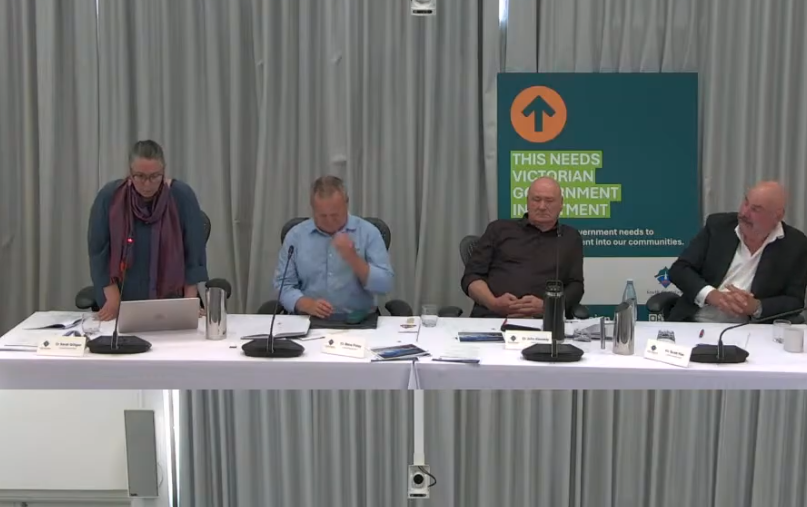
The horrifying attack on independent Federal MP Helen Haines cast a shadow over the South Gippsland Shire Council chamber on Wednesday 21 October. The member for Indi was rammed twice by a vehicle near her electorate office in Wangaratta and left in a critical condition, losing both her legs. A 43-year-old man was arrested at the scene. The community has been reeling, and politicians from across the spectrum have noted that hate-filled speech and threats of violence are increasing.
During her Councillor update at the 21 October meeting, Cr Sarah Gilligan described what she called the “hateful eights”: dedicated groups, often men, who target councils on social media, throw accusations at elected members, and consume hours of staff time with complaints designed to exhaust rather than inform. “The more people like you out there, the less people like me will run for political positions,” she told the chamber.
Mayor Nathan Hersey reinforced Cr Gilligan's remarks, and said the council offices in Leongatha would be lit up in white on 23 October as part of the nationwide vigil in support for Dr Haines, her family and community.
Local Monash MP Mary Aldred described the attack on Dr Haines as “abhorrent” and said the temperature of Australian political discourse had been rising for some time. “This is an appalling, violent attack on a parliamentarian who is universally regarded as gracious, hardworking and thoughtful,” Aldred said. “It is also an attack on the democratic will of the people of Indi, who sent her to Canberra as their representative, and an assault on our parliament and our system of democracy.”
Aldred said she feared Australia was losing the ability to respectfully disagree on big issues but also pointed the finger at misogyny and hate. In a speech in parliament on 26 October, Ms Aldred, “the threats against women in this place must be named. Men face them too, but women are over-represented in a particular type of abuse. Like all female parliamentarians, I face an inbox and social media feed with continual gendered and sexualised comments.”
Governor-General Sam Mostyn, speaking on ABC Breakfast, raised serious concerns about hate speech and the level of anger directed at women in Australian public life. Appearing with Dr Haines’s husband Phil after the incident, Mostyn appealed to Australians to “learn or relearn to exercise our muscle of decency.”
The following day, Mostyn revealed that overnight, comments had been posted on her Instagram page “in capitals with expletives, once again questioning the very nature of what it is that I do.”
Back in the South Gippsland Shire chambers, Councillor Gilligan noted that councils manage hundreds of millions of dollars in community assets, navigate complex state and federal policy, and make decisions that shape where people live and how they move through the world. They do this, increasingly, while absorbing a level of hostility that would drive most people away from public service entirely.
Cr Gilligan called for an end to the dehumanisation of public discourse. “Think about the tone of debate, the old school Australian political bully-boy banter in our chamber that's on Question Time. Think about the casual misogyny and veiled sexual threats we hear about all the time in Australian politics. Social media has dehumanised us and it has to stop.”
“As Councillors, we are out there, out and about, engaging amongst it. We are regional people living in our communities, just as Helen was. Tone is everything and words are weapons. That is the start,” Cr Gilligan concluded. Cara Schultz