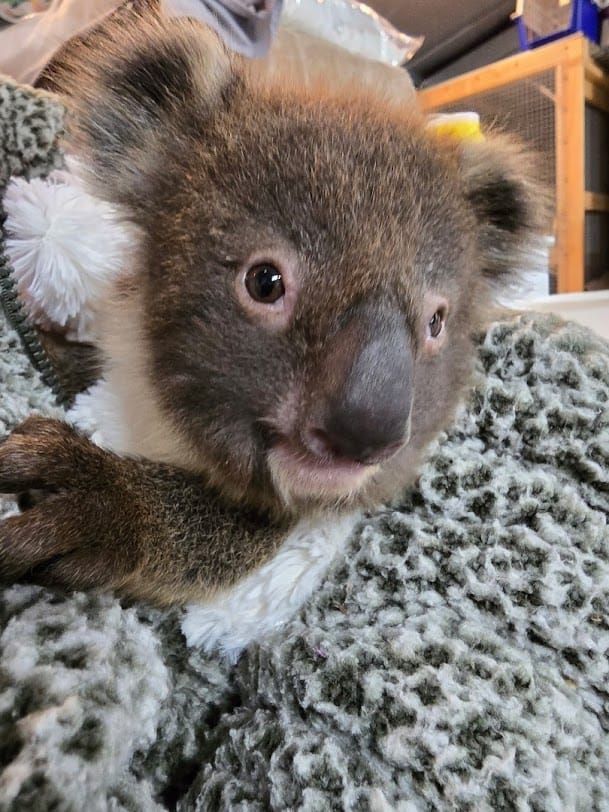
Victoria’s koala population may be considerably smaller than previously estimated, but for wildlife carer Sue Moore, the koalas coming into care along the Prom Coast tell a more complicated local story.
Ms Moore, who has cared for wildlife for more than 20 years, said she had dealt with about 85 koalas in the past 12 months, including animals injured by cars, dog attacks and disease. “I haven’t really seen a huge reduction in numbers,” she said. She had seen some older, thin koalas and several cases of mange, although only a couple of chlamydia cases in the past year.
Her observations of where koalas are being seen, however, point to ongoing pressure on their habitat. Ms Moore said Walkerville, which once had 13 or 14 koalas in the area, now had fewer, with housing development, a lack of new gum tree planting and increasing traffic among the factors she had observed. Friends in Bear Gully had also gone about three months without seeing a koala before one recently appeared, while Tarwin Lower had historically supported quite a few koalas.
Ms Moore said koalas moving through the dairy farming areas between Tarwin Lower and Yarram were increasingly reliant on vegetation corridors, with animals sometimes forced to cross roads or move through areas where they were vulnerable to vehicles and livestock. She said she had picked up koalas that had been injured after crossing farmland.
“The koalas are still coming in, but the thing is that means they’re on the move,” she said. “So, they’re going across roads more still. So, they’re still getting hit. So, they haven’t got that habitat where they can stay.”
Her comments come as the Arthur Rylah Institute’s Great Victorian Koala Survey provides the first comprehensive statewide assessment of the species. The survey estimated Victoria’s koala population at about 225,000 in 2024, compared with previous estimates of about 460,000. ARI says the difference reflects the new survey and modelling methodology rather than a sudden population decline.
The survey also found significant genetic differences between Victorian koala populations. South Gippsland, including Wilsons Promontory, was identified as one of three major genetic clusters and had the highest genetic diversity of the three clusters identified in the state.
Health was another concern. Detailed assessments of 68 koalas from seven locations found 29 were in chronically poor health and were euthanised on welfare grounds. Infectious organisms were detected in 59 per cent of the animals assessed, while chlamydia was detected in 43 per cent.
For Ms Moore, habitat remains a key issue at a local level. “The more plants, the better,” she said, pointing to the importance of maintaining and extending vegetation corridors. She is also working towards establishing a future koala “nose printing” network, which would use the unique patterns on koalas’ noses to identify individual animals, record sightings and track movements. The project is still being developed and is not yet operating.
The statewide report was completed in 2025 and has since prompted the Victorian Government to announce $2.6 million for koala conservation. David Barrett