There’s been plenty of strong feeling about the proposed Main Street “upgrades” in Foster these past weeks - and rightly so. It’s the heart of the town, and people care about getting it right.
After seeing the reaction on our social media page, I wanted to take the conversation a step further and look at an alternative that might not have occurred to most: the Dutch “woonerf” - or living street.
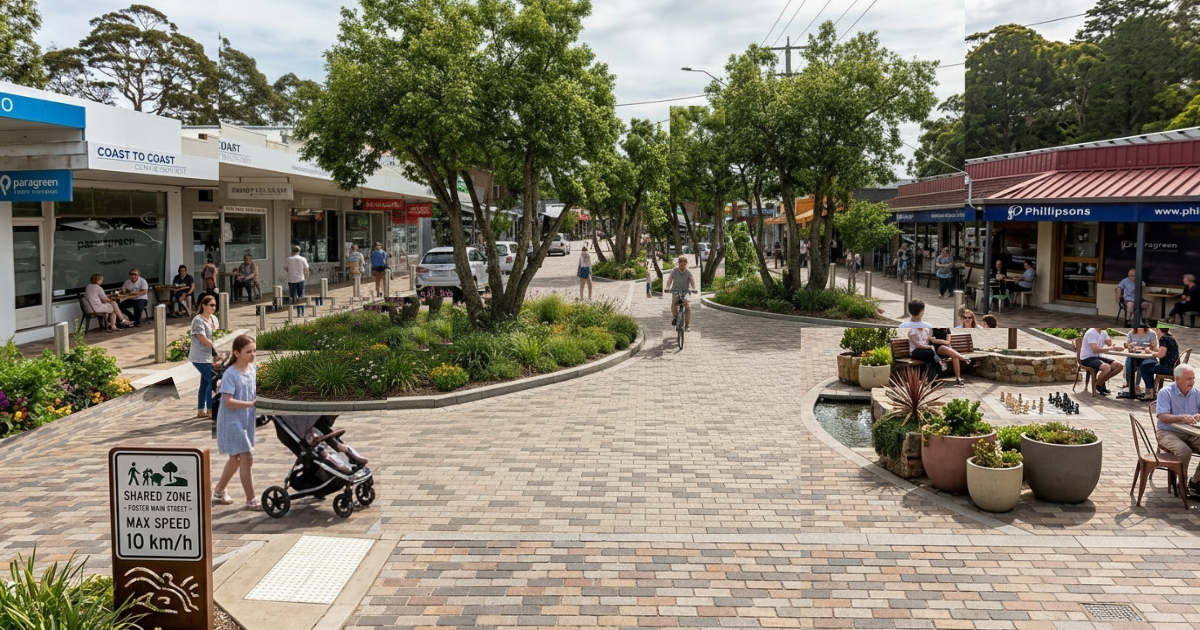
For those unfamiliar, a woonerf flips the traditional road design on its head. Instead of cars dominating, it creates a shared space where pedestrians, cyclists and drivers all mix at very low speeds. No kerbs, no straight-line racing, just a street that feels like a place to be, not something to pass through.
To get a real-world perspective, I reached out to my cousin who lives near Delft in the Netherlands, one of the first places to adopt the concept.
“The design effectively forces a change in mentality for drivers, leading to the impression that "I am a guest here," rather than "I'm in charge", Jonathan told me.
"It's hard to convey in words the pleasant feeling you get while walking through these streets. By eliminating the curb and separation between vehicle traffic, residents and children are given free reign to move in what is now a beautiful public space”, he concluded.
It’s one thing to hear it works overseas, but would it work here?
I also spoke with Dr Elek Pafka, senior lecturer in urban planning and urban design at the University of Melbourne, to get an expert view on whether a town like Foster could realistically adopt something similar.
He began with, “Narrowing the lane width itself is a possibility, I would start with that if I'm looking at Foster now. The street is fairly wide, the footpaths are rather narrow and the lanes for cars are quite wide, which encourages high speed. So an easy first step would be to just broaden the footpaths.”
He told me cobblestones or any kind of pavement that's made of small elements, would make fast driving uncomfortable for drivers, but also produce a bit of a noise that makes it safer for pedestrians to know when a car is approaching.
Elek went on to explain the origins of woonerf. Transport engineer Hans Monderman came up with the concept in the 1960s and his proposition was extremely radical.
Monderman suggested putting up signs at the entry and exit of towns saying there's no traffic rules here, you judge what's safe - putting the onus of who's responsible if something bad happens back to the person rather than the state saying it's safe to drive at a certain speed.
From both perspectives, one thing is clear: streets like this are designed to slow traffic not by signs or enforcement, but by how they feel to drive through.
And that’s really the question for Foster.
Do we want a street that moves cars efficiently through town, or one that encourages people to stop, cross easily, sit, shop and spend time there?
This isn’t about copying Europe for the sake of it. It’s about asking whether there’s a better way to make Main Street safer, more inviting, and better for local businesses. And most importantly, safer. The numbers don’t lie. Woonerf works, you only have to look at the data to see that accidents, or even near accidents, are vastly reduced where it is adopted.
The current plan has opened the debate. Maybe this is the moment to think bigger.
Would you support Foster exploring a woonerf-style Main Street?
— David Barrett, Deputy Editor, Prom Coast News