There's been no shortage of strong feeling about the Council’s proposed upgrades to Foster's Main Street, and a suggestion that the town consider a radically different approach has sparked one of the liveliest conversations on the Prom Coast News Facebook page in recent memory.
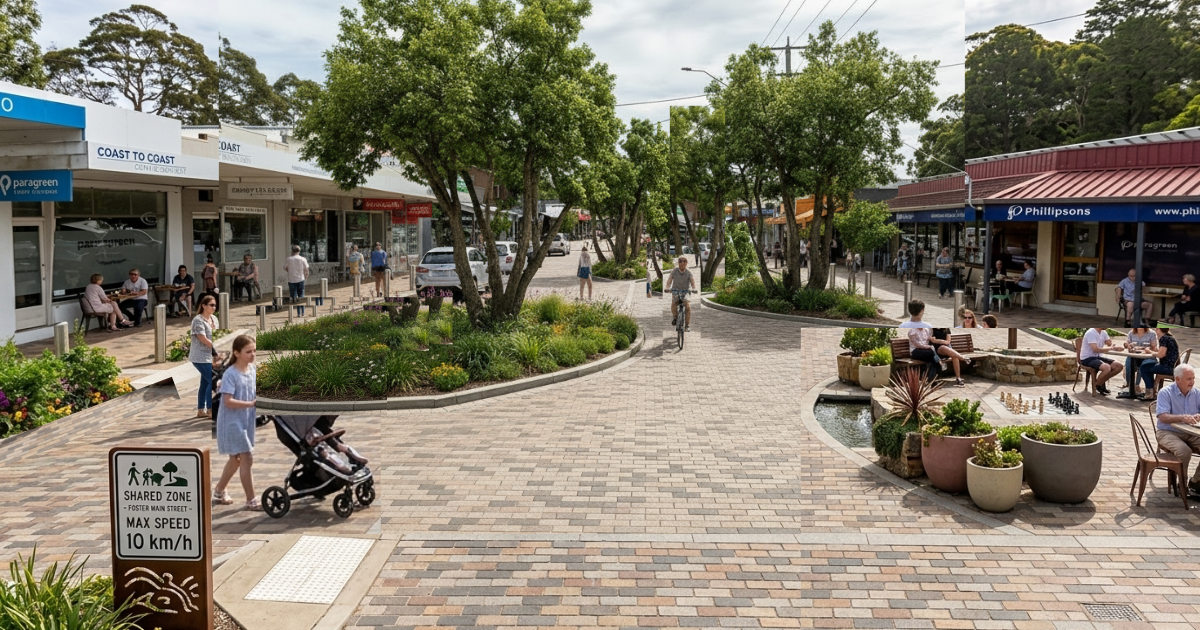
I proposed exploring the Dutch concept of a "woonerf", or living street, as an alternative to the current plan. A woonerf flips traditional road design on its head, creating a shared space where pedestrians, cyclists and drivers all mix at very low speeds, with no kerbs and no straight lines that encourage speeding. The street becomes a place to be, not something to pass through.
The reaction was immediate and divided.
"This looks amazing and would create a wonderful atmosphere during peak tourist times — it really gives the village a warm, inviting feel," wrote one commenter. Others were more cautious, noting that local businesses rely on customers being able to pull up directly out front, and raising concerns about parking access for elderly residents and people with disabilities. "The parking behind the shops is too far away for us oldies and those with walking issues," wrote one person. "Will shop and stop elsewhere." Another was blunter still: "This is a rural farming town, not an extension of Chapel Street."
But others pushed back. One reader argued there is "plenty of parking out the back of the shops" and that a woonerf needn't exclude those who need to drive, including emergency services and people needing drop-off access. Another noted that the rear car parks, including several disabled spaces and the museum car park, are "not utilised enough."
To get a real-world perspective, I reached out to my cousin near Delft in the Netherlands (one of the first places to adopt the woonerf concept). "The design effectively forces a change in mentality for drivers, leading to the impression that 'I am a guest here' rather than 'I'm in charge,'" Jonathan told me. "It's hard to convey in words the pleasant feeling you get while walking through these streets."
Dr Elek Pafka, senior lecturer in urban planning and design at the University of Melbourne, offered a more measured starting point for Foster specifically. "Narrowing the lane width itself is a possibility, I would start with that. The street is fairly wide, the footpaths are rather narrow and the lanes for cars are quite wide, which encourages high speed. An easy first step would be to just broaden the footpaths." He also noted that cobblestones or small-element paving would make fast driving uncomfortable while giving pedestrians an audible cue when a car is approaching.
The concept has its roots in the work of Dutch transport engineer Hans Monderman, who in the 1960s proposed removing traffic rules entirely from shared spaces and putting the onus of responsibility back on the individual driver rather than the state. The results, wherever the approach has been adopted, have been striking: accidents and near-misses are vastly reduced in woonerf-style streets.
And it would be healthy too, a point backed by a new study released last week by the Menzies Institute for Medical Research at the University of Tasmania. It found that residents in highly walkable regional towns walk 75 minutes more per week than those in low-walkability areas.
Senior author Professor Verity Cleland said that with regional Australian towns experiencing unique health challenges including higher rates of preventable chronic disease, improving walkability could offer a simple, but effective solution to help address health inequalities.
“Imagine if all Australian towns were built with walkability in mind – everyone would be able to travel easily and conveniently on foot, boosting their health while saving money on fuel and protecting the environment,” said Professor Cleland.
“But traditionally government planning and funding has prioritised roads and driving, particularly in regional areas, leading to lack of well-connected footpaths and facilities. Our research uncovered a higher number of regional areas that had low walkability compared to urban areas.
With fuel prices continuing to rise and more Australians looking for alternatives to the car, the timing of that research feels relevant. The question for Foster is a simple but significant one. Do we want a Main Street that moves cars efficiently through town, or one that encourages people to stop, cross safely, sit, shop and stay a while? The current proposal has opened the debate. Perhaps this is the moment to think a little bigger. David Barrett